
Deplorable

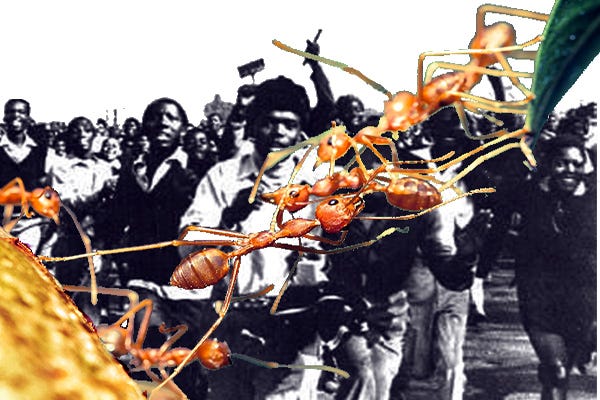
Even if the slovenly rate at which progressive law is implemented were remedied, there’s a bigger problem. It’s the discovery made by the biologist, E.O. Wilson, in his obsessive study of ants. In an hesitant reply to a belligerent questioner at the Newberry Library three decades ago, Wilson finally bellowed, “The problem is that you’ve empowered the ignorant!” Which, he hastily added, is what ants do successfully, but what human societies have only managed at their peril.
Progressives might have good agendas for governing stable, productive and just societies. But they’ve never acquired sufficient power to do so, because they ignore Wilson’s zoological discovery uncannily applied to human politics: the empowerment of the ignorant. This highly complex conundrum which rewards ignorance with enlightenment is why Trump controls the moment. He harnessed the hyper individualism of proud folks in a decaying society. Until the Left wrests this from the Right, the Left is at a dead-end.
They hated the posho handed them in dirty scarves that their Teso “wives” brought them at midday. They hated the sun, which turned the posho to stone during the women’s long walk from the village to their Tororo border post. They hated the few coins they felt they had to give them. They were Kakwa, like their most beloved leader, not Teso, and they were displaced the entire breadth of their country to this despicable little interior border post that no one used ... except me.
I occasionally crossed through the border post to visit the adjacent city of Tororo, Uganda, ostensibly to find petrol for my car that the little villages around our Kenyan school didn’t provide. In truth, though, I drove through the post because the thing that the guards hated the most, hated almost beyond any rational explanation, was education. I was a teacher of Teso boys, most of whom lived in Uganda not Kenya, and who risked their lives to further their education by sneaking across the border. There were few schools left in Uganda under Idi Amin, and they were specifically prohibited in the despised Tesoland which had been slow to embrace Amin’s reign. I was warned that soldiers had orders to kill any teacher found in Tesoland. I couldn’t pretend to be a Peace Corps, because Amin had just rounded up all the Peace Corps there and was holding them in terrified detention. So I pretended to be a missionary like Father Charlie from Ireland and Father Jerry from Scotland who ran our school, and whom they also let cross the border. But I was too young to be a priest, so I said I was a seminary student. Amin’s paranoia would eventually extend to all Christians as well, but not yet in 1973.
When word came that some kid was going to try to slip through the bush in the narrow valley where the post was located, I drove my VW minibus/safari vehicle to the border and talked up the two guards before bribing them with some sugar to let me cross. Technically the border was closed. So the talk took a good amount of time. I was 25 but they were much younger. I was a Mzungu (visiting foreigner); they were Kakwa but also considered ferenji (foreigner) by many in Tororo. So that was our bond, and not much else. I was white, or red when sun-burned which quite amused them, since they proudly unbuttoned their heavy uniforms to show me the spit-shined deep blackness of a Kakwa chest bared midday in the scorching March heat. So we had a lot to laugh about, particularly since we didn’t know each others’ language. It all took time. Time enough for a 12-year-old to crawl around whispering thorn bushes into a land of enlightment.
Every morning at seven o’clock Radio Uganda came on air. The announcer spoke in perfect American not British English, curiously, and shouted as if at the end of a tunnel:
“His Excellency, the Almighty President of Uganda, General-in-Chief of the Revered Armed Forces of Uganda, President of the National Assembly, Chief Judge of the High Court, World Boxing Champion, [and at this point the announcer would add something different each day, like ‘ Esteemed Head of the Boy Scouts’] last night dreamed...”
And he dreamt all sorts of things. He dreamed how to end the Yom Kipur War. He dreamed how to win the “swimming contest” at the Olympics. He dreamed that if he were a woman, Richard Nixon would have married him. And on some day in March, 1974, he dreamed that his country should open for tourism.
Three years after Amin had massacred his way to power, the news coming out every day of the continuing genocides of certain tribes and the widespread indiscriminate barbaric killings by his soldiers was only increasing. The announcement that Amin felt the country was now ready for tourism was SNL-hilarious were it not so macabre. Who on earth would dare go into the country that was humanity’s slaughterhouse?
Kathleen and me.
I couldn’t help it. I was somehow the best of friends with two affable, young border guards at Tororo whose commander-in-chief was probably the world’s most savage killer. I knew they considered themselves his soldiers, elevated citizens – patriots of the first degree, but they hardly seemed like killers. At times I nearly forgot the Fathers’ warning to hide my profession, as they seemed little different than some of my older students. If it weren’t for Amin’s dream, my understanding of the tens of the thousands of them would have ended there, at the border.
When word got around that we were going into Uganda, all sorts of requests came flooding in. Nairobi was two to three-days drive in those days from where we lived. There were few phones which rarely worked anyway, but somehow we started to receive dozens of requests from people in Nairobi to take things to people they hoped were still alive in Uganda.
I don’t remember everything we somehow managed to take, but keep in mind that we had to take all of our own food, emergency petrol, gizmos for purifying water and fixing spark plugs, lots of extra matches and ‘paraffin’ for our lamps, soap, batteries and who remembers what else, for the two to three weeks we anticipated necessary to travel the circumference of the country. Still, I managed to include a dozen Bibles for Bishop Luwum of Kampala (who would be arrested and killed five years after I delivered them), dog treats for two nuns at a school in Masawa, letters (which I was unable to deliver) to a jailed Philadelphia Enquirer reporter, and spare parts for a Landrover as well as a book of Robert Frost poetry for the English teacher at the Kigezi High School, the country’s most prestigious high school which rumor had was surviving in the far southwest of the country. All of this was carefully stashed under my VW’s raised floorboard, topped with several dozen kilos of packed flour and sugar as bribes for any investigating soldier. Off we went.
Throughout my life of close encounters I’ve conveniently been able to forget the worst parts. But there were too many worst parts on this trip, and my young adult brain was stuffed to capacity long before we reached the other side of the country, about ten days later, driving into the presumed single high school in the country that was still operating.
During the colonial period Kigezi High School was often quietly referred to by the foreign parents working in East Africa as Uganda’s “Prince of Wales” school. The alias was part code, part affectation. British colonials working in East Africa mostly sent their children to expensive schools back in Britain, or slightly less expensive schools in South Africa. But the least expensive of all was Kigezi, and it wasn’t bad. Many of the faculty were volunteers from well-known British public schools, in return for continued pension infusions during their two-year absence. Other nationalities working in East Africa, like American missionaries, also adored ‘Prince of Wales.’
But in Kampala we learned that only a fraction of the faculty was left to take care of maybe “twenty or thirty” boy students who remained in a co-ed institution accustomed to 300. But yes, we learned, it was surviving. Why? How? Well, we were told, until just a few days ago Amin had his boys there. He had many young boys from many wives. Before Amin’s coup, the schools in the Kabale/Kigezi area of Uganda were considered the finest in East Africa. The school term at Kigezi wasn’t supposed to end for another two weeks, but Amin had pulled his sons out early for some reason.
Much of southwest Uganda is a beautiful, lush highland jungle, and its largest and most important city is Kabale. The school was just on the outskirts. But much of the gorgeous highland forests had been preserved as the school’s perimeter, so it was like a highland jungle in the middle of a city.
The first thing we passed crossing into the school grounds was the football pitch, which as the Long Rains had begun was an extremely lush, deep green. But there wasn’t a soul on or around this most favored place for boy students yet it was mid-afternoon. Not even the cold or darkened afternoon or even the light rain from the thick fog/clouds that were so low they hid the tops of the forest trees, would normally keep Kigezi boys from playing soccer.
We pulled up to the first teacher’s cottage we saw. No one, of course, knew we were coming, but in Kampala we learned the names of the few who remained.
I knocked and knocked on the first cottage, then the second cottage, but all that happened was that I rattled off some of the thick moss and ivy from the door frame. Same thing happened at the third cottage, but I was sure I heard someone inside.
“Get in!” I heard before the door was completely opened for us, and then even before she shut it behind us her head was nodding furiously, her words having trouble coming from her thoughts.
“Ge-it ge-get your car out of there. Put it behind the cottage!”
I glanced at Kathleen who was quite capable of handling the world, alone. She’d defied school boy monitors’ threat to kill her if she insisted on trying to teach, as she was the first woman to do so at our remote Kenyan school. Nevertheless, I was worried about leaving her for even a few minutes as I moved the car. She motioned for me to go alone. Our woman host would more likely confide in her if I weren’t there, however short that would be.
Kathleen and our woman host were embraced when I came back in, the woman sobbing. The previous morning the Headmaster had called for an unusual assembly on the school pitch (soccer field). Usually it was in the dining hall. Everyone turned out in the cold drizzle, some with umbrellas. The boys neatly lined up by classes, placing their umbrellas at the side, faces wet and shining. As was traditional, the Head Boy stood at the front. A big Army truck with a dozen soldiers suddenly arrived. The soldiers lept out of the truck, ran furiously towards the kids shooting them all dead. In a few minutes they threw the lifeless bodies of 23 boys in their beautiful, thick woolen sweaters and dark green shorts into the back of the truck and sped away.
Why didn’t they kill the teachers who remained, the other staff?
They may need us next term if Amin decides to send his boys back. We’re prohibited from leaving the grounds. How’d you get in?
Moments later the three of us are startled by a creaking sound. We follow our host’s gaze to the pantry door which opens slowly. It’s a tall, thin African in a misfitting, tattered suit. The sleeves of his jacket are above his bony wrists and his frayed black nylon socks easily show below the flaccid cuffs of his pants. His shirt collar is opened to the second button, the tie loosened. Once he saw the three of us he slid into the room like a laser beam. He was the history teacher. Please, he whispers politely his lips practically touching my ear, I must go with you. I will always remember the smell of his breath. Our woman host looks at me desperately. She starts her head nodding to force out the words: They’re sure to kill him, she says.
We left almost immediately. I couldn’t take him. Not even just to the next town. Not even just outside the school perimeter. I was very young, but I was learning faster than I’d ever expected the danger lines in a horrible world that usually only battle-worn soldiers understand.
We left while the late afternoon rain was still pattering the killing field, driving slowly because that was also softly. I stopped briefly at the end of the soccer field to seem nonchalant but in fact to stare back through the goal posts over the empty field. It was getting darker by the minute, and as I turned my head out of the window to start the car going, again, my gaze fell on an umbrella lying there on a ground like a prehistoric black moth killed in flight.
Five minutes, twenty minutes later, an hour or two, out of the forest, out of the mountains, three weeks later in my bed in Kenya the memories are almost gone, fleeing like the dust off a dead insect tumbling over a wind-swept field. All that remains is the smell of his breath: Like a closeted, dusty cabinet with bits of acrid tobacco. Then a few years later back in Chicago when my office building catches on fire, or five years later back in Zanzibar when the police open fire on the soldiers, or ten years later in The Congo when Rhodesian sanction busters tuck us into the belly of an old DC3 around an APC, twenty later in the Rwandan genocide with bullets and tanks, or now...
... a door opens slowly in my room, or a thin African serves me a beer or a polite, desperate voice asks me to do something that I know I can’t. Memory after memory after memory flies out of a giant drawer of jigsaw cardboards, clasping together like desperate magnets, locking forever the image of a deep, green field laden under a dark, dismal afternoon surrounded by black forests smothered in fog, with not a sound or a movement but the irregular plop-plops of water dripping like syrup from a goal post onto the flaccid sheets of a black umbrella.
****************************
Why are despots and autocrats so fearful of education? Well, it’s pretty simple if you ask it from their point of view. We smarter people can figure out how to stop them.
But what if we don’t stop them?
Then, you get Amin. Or... Trump.
Scary conjunction of Amin and Trump.